Is it bad to charge your phone overnight?
By Ultra Team
Published May 4, 2026
It’s a habit many of us have: we head to bed and plug in our phone right before we fall asleep so that it can charge overnight. Despite being so common, you may have heard conflicting advice over whether or not our phones should charge overnight. Some people say they may overheat, others that they may overcharge. Luckily, modern smartphones are much safer, and smarter, than you think.
In this article, we’ll clear up the myths about charging overnight, as well as, best phone charging practices.
How smartphone batteries work today
Modern smartphones use lithium-ion batteries. Unlike older batteries, they have very little “memory effect.” Older batteries that were made of nickel would often “forget” what their full capacity was, which is why it was advised to drain your battery before recharging.
Lithium-ion batteries also have built-in charge management systems, which prevents them from overcharging. Modern batteries stop charging when they are 100% charged.
Should you charge your phone overnight?
The short answer is that charging your phone overnight is generally safe. Smartphones regulate charging automatically and overcharging is not a problem since phones stop at 100%. After that, they start “trickle charging”: delivering a low and slow amount of power to keep the battery at 100% charged without overheating or overstressing.
Speaking of overheating, heat is the actual concern when it comes to charging your phone overnight. Phones have chips that prevent them from overheating, but leaving it under your blanket, pillow or other heat source in your room can help speed up battery degradation and can also be a potential fire risk.
Is it good to let your phone die?
Despite common misconceptions, regularly letting your phone die is actually not good for its battery. Dropping to 0% can put extra stress on battery cells and over time reduce your battery’s overall health and lifespan. Generally, it’s best to leave your battery between 20-80% whenever possible and always charge before it hits 0%. If you find yourself constantly dropping to 0%, you may want to learn more about what is draining your phone battery.
What actually damages your battery
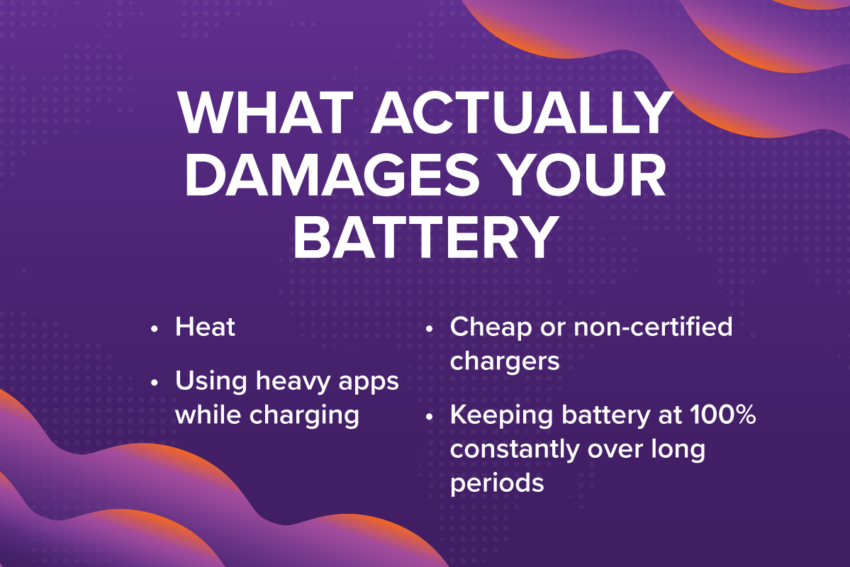
Charging overnight doesn’t damage your battery. So what does? Here are a few things that are actually harmful to your battery:
- Heat: As mentioned above, charging your phone under pillows or blankets or near another heat source can actually degrade your battery over time, as well as pose safety risks.
- Using heavy apps while charging: Charging your phone while also running apps that use a lot of data, such as a streaming app or mobile game app, can accelerate battery aging because of heat build-up.
- Cheap or non-certified chargers: Using a cheap, uncertified charger can be a serious risk because these products may not have the necessary safety circuits found in certified chargers, which means they may not be able to properly regulate your phone’s temperature and voltage.
- Keeping battery at 100% constantly over long periods: Charging while already at 100% can also create heat buildup and affect your battery’s lifespan. Keeping it at 100% can also create stress on your battery and accelerate your battery’s degradation.
Benefits of overnight charging
Despite common myths about the dangers of overnight charging, there are actually several benefits to overnight charging, such as:
- Convenience and consistency: It is extremely convenient to start your day with your phone at 100% and prevents things such as needing a mid-day charge.
- Works well with optimized iPhone and Android charging features: Optimized charging, a feature found in both Android phones and iPhones, delays the final 20% of your charge just before you wake up, which helps protect your battery’s health. See below for how to enable these features.
Overnight phone charging tips
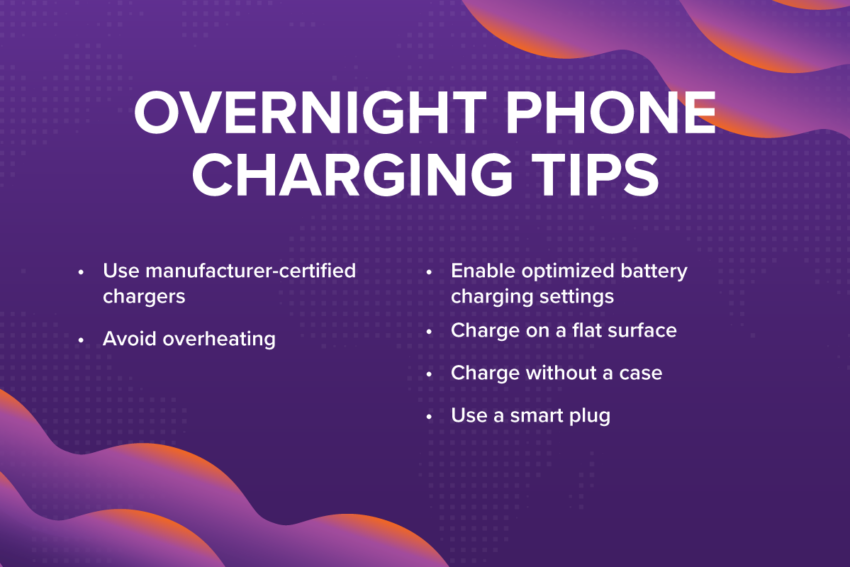
If you want to keep charging your phone overnight, here are a few tips to keep you and your phone safe—and preserve your battery life.
- Use manufacturer-certified chargers: As mentioned above, using a non-certified charger can be dangerous, as they may not have the safety features needed to protect your phone. Using a manufacturer-certified charger is the safest way to charge your phone.
- Avoid overheating: Don’t charge your phone under your blanket and pillows. Instead keep your phone well-ventilated while you charge it. Learn more about what makes phones overheat.
- Enable optimized battery charging settings: Use the steps above to turn on optimized charging for your specific device.
- Charge on a flat surface: Charging on a flat surface is essential for properly dissipating heat and preventing your phone from overheating. It also reduces fire risks.
- Charge without a case: Just as with charging your phone on a flat surface, charging without a case helps prevent overheating.
- Use a smart plug: These plugs can be scheduled to turn off once your battery hits a certain percentage (most commonly around 80%). Your phone may even have this feature. Here’s how to check for both iPhones and Android phones:
Optimized charging for iPhone
- Go to Settings
- Scroll down to Battery
- Click Battery health & charging
- Toggle on Optimized battery charging
Optimized charging for Android phones
- Go to Settings
- Look for Battery & device or just Battery
- Go to Manage battery usage
- Click on Optimized
Now you’re an overnight charging expert
As you’ve read, overnight charging is safe for most users thanks to the modern technology found in today’s smartphones. However, there are still things you can avoid, such as heat, to keep you and your phone safe, as well as small habits you can adopt to extend your battery’s lifespan and keep it reliable. Speaking of reliable, if you’re looking for an Ultra-reliable service, you’ve found it. Tap the button below to learn more about Ultra Mobile and our plans.